The People's Gallery is a series of large murals painted on the gable ends of buildings along Rossville Street in the Bogside, the neighbourhood just below Derry's walls. They were created by the Bogside Artists, a group of three local men (Tom Kelly, William Kelly and Kevin Hasson), over roughly a decade from the mid-1990s.1 Together the murals set out the Bogside's own account of the civil-rights years and the Troubles as they were lived on these streets.
What follows is a short, factual description of the main murals in the order most people meet them walking down Rossville Street.2 The events they depict are contested history, and the gallery presents them from the perspective of this community. We have tried to describe what each mural shows and the event it refers to, and to stay with the established record. Verify confirm the exact running order and current titles of the murals on site, as some have been added, moved or restored over the years.
The Petrol Bomber
A young man in a gas mask holds a petrol bomb, with the Rossville flats rising behind him. It marks the Battle of the Bogside in August 1969, several days of clashes between residents and the police that saw the area barricade itself off.3 The unrest was one of the events that led to British troops being deployed to Northern Ireland.
Bernadette
This mural shows Bernadette Devlin, then a young civil-rights activist and MP, with a loudhailer, alongside a woman banging a bin lid against the ground. Bin lids were used across the area to warn neighbours of raids and incursions. The image stands for the community organisation of the Battle of the Bogside and the prominent part women played in it.4
The Death of Innocence
A young girl stands against a dark background beside a downward-pointing broken rifle and a butterfly. She is Annette McGavigan, a schoolgirl killed by gunfire in 1971 while out on the street.56 Verify Annette McGavigan's age and the exact date in 1971. The broken rifle represents an end to violence, and the butterfly, repainted in colour after the peace process, stands for hope. The mural is dedicated to the children who died during the Troubles.
Operation Motorman
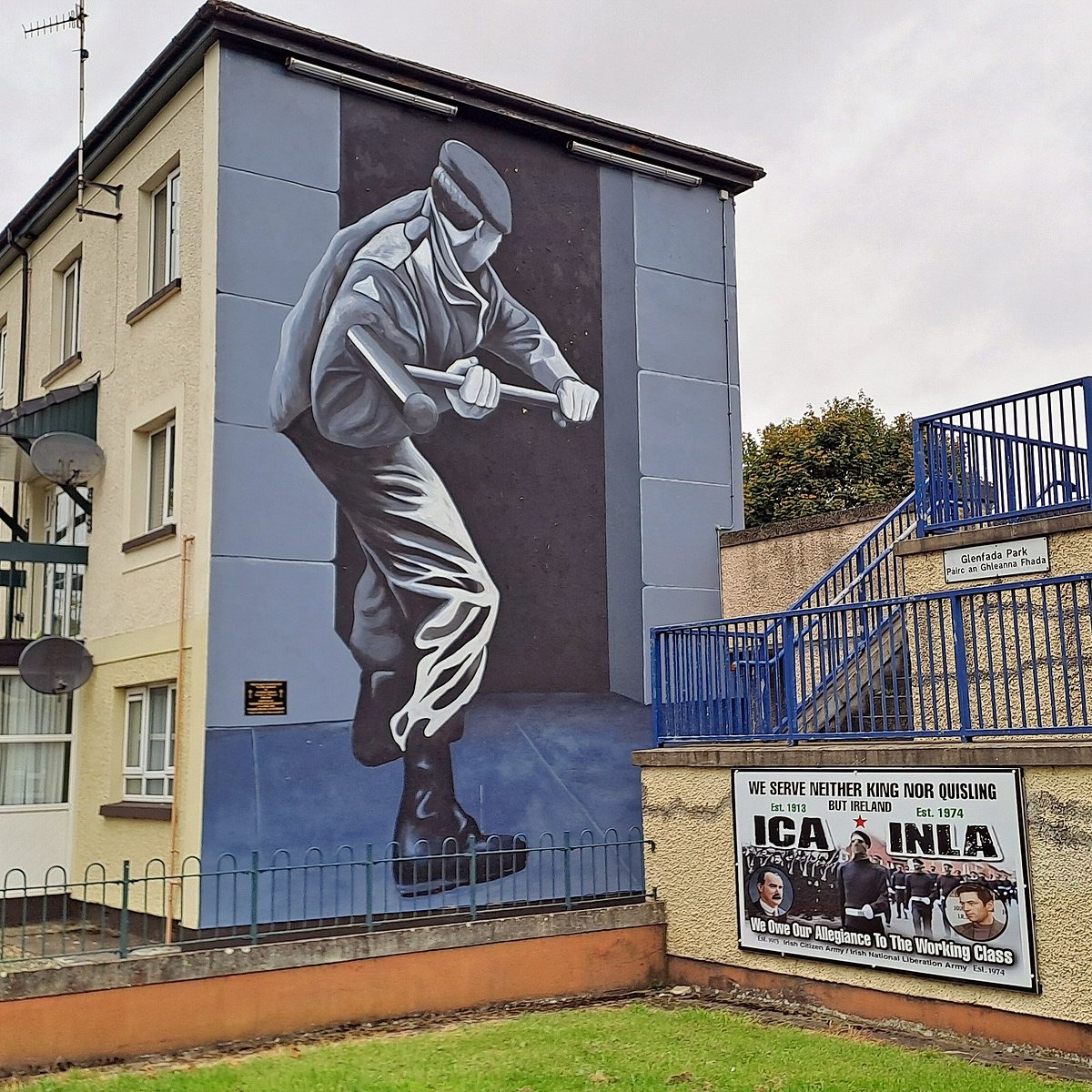
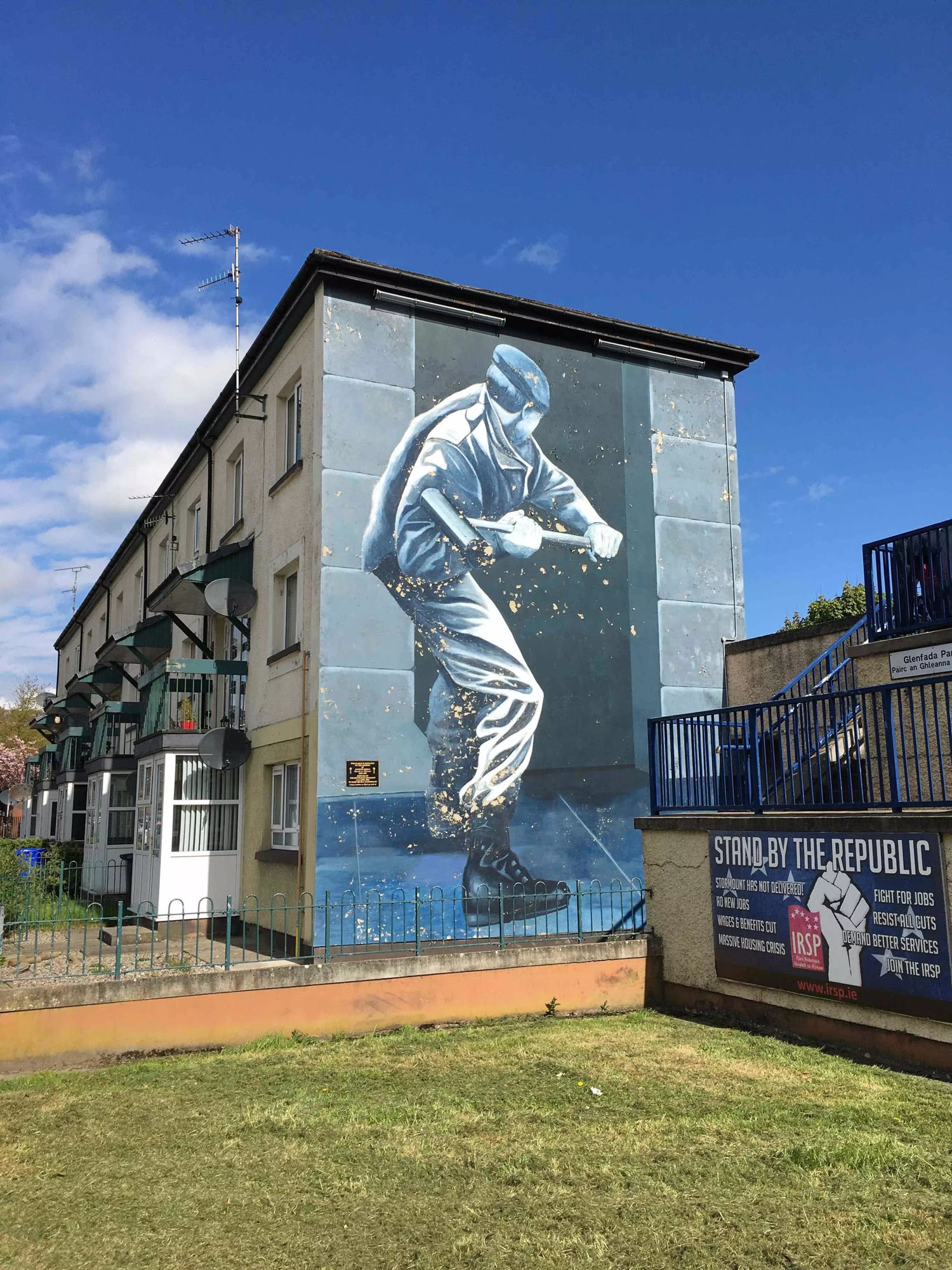
A British soldier swings a sledgehammer to break through a door. This refers to Operation Motorman in July 1972, the large army operation to dismantle the "no-go" areas, including Free Derry, that had been sealed off from the security forces.78 Verify exact date of Operation Motorman.
Bloody Sunday
Perhaps the best known of the murals, it shows a priest, Father Edward Daly, later Bishop of Derry, waving a bloodstained white handkerchief as a group of men carry a mortally wounded young man, Jackie Duddy, to safety.9 It marks Bloody Sunday, 30 January 1972, when soldiers of the British Army's Parachute Regiment opened fire during a civil-rights march against internment. Thirteen people were killed on the day and a further person died later.10 Verify the figure of thirteen killed on the day and the timing of the fourteenth death.
The Saville Inquiry, which reported in 2010 after a long re-examination of the events, concluded that those killed and wounded were unarmed, that none was posing a threat that could justify the shooting, and that the soldiers' firing was unjustified.11 Following its findings the Prime Minister made a formal apology in the House of Commons.12 We keep to those findings when we talk about that day.
The Saturday Matinee
A youth prepares to throw a stone towards a British armoured vehicle amid clouds of CS gas. It captures how, for a time, confrontation between local young people and the army became an almost routine weekend event in the area, the "matinee" of the title.13
Civil Rights
This mural commemorates the civil-rights movement and the marches of 1968 and 1969 that called for reforms including fair housing and "one man, one vote."1415 Derry was a focal point of that movement, and the mural marks its banners and its marchers rather than any single day.
The Hunger Strikers
A commemoration of the republican hunger strikes in the Maze prison in 1980 and 1981, during which prisoners refused food in pursuit of political status.16 The mural includes a figure of a "blanket man" and remembers those who took part, among them men from Derry. Verify the specific figures and names shown in this mural.
The Peace Mural
The most recent of the series and, deliberately, the most hopeful. An abstract dove made of coloured squares rises upward, set against an oak leaf, a nod to the Irish word doire, the oak grove that gives Derry its name. It was painted to close the gallery on a forward-looking note as the peace process took hold.17 Verify the year the Peace mural was completed.
Seeing them for yourself
The murals are outdoors, free to see and visible at any hour, though they are best appreciated slowly and in daylight. Photography is welcome, but they sit within a living neighbourhood, so it is worth remembering that this is home to the people around you, not only a gallery. Near the murals you will also find the Bloody Sunday memorial and the Museum of Free Derry, which set the images in fuller context.18 Verify Museum of Free Derry opening hours and admission.
The gallery is also tied to the calendar of the city. Each year, usually in late January, a commemoration is held in the Bogside to mark the anniversary of Bloody Sunday, and the streets around these walls become the focus of it. Verify the timing and current form of the annual Bloody Sunday commemoration. Visiting at any time of year, you are looking at how one community chose to record its own past in public, on the very ground where much of it happened. That is what gives the People's Gallery its weight, and why it repays the time to walk it properly.
Read on their own, the murals give you the outline. Walked in order, with the streets and the memorial around them, they tell a far more complete story, which is exactly what our Bloody Sunday and the Bogside Murals walking tour is built to do.
Sources and references
The numbered marks in the article link down to this list. Each entry says which claim it backs up, so anything here can be checked at the source.
- The Bogside ArtistsCAIN, Ulster UniversityThe Bogside Artists: Tom Kelly, William Kelly and Kevin Hasson, and the years they worked.
- The People's Gallery: the muralsCAIN, Ulster UniversityThe full set of murals in the People's Gallery and where each one stands on Rossville Street.
- The Petrol Bomber muralCAIN, Ulster UniversityWhat the mural shows and the Battle of the Bogside in August 1969 that it marks.
- The Bernadette muralCAIN, Ulster UniversityBernadette Devlin, the bin lids and the part women played in the Battle of the Bogside.
- The Death of Innocence muralCAIN, Ulster UniversityThe mural of Annette McGavigan, the broken rifle and the butterfly repainted in colour.
- Sutton Index of DeathsCAIN, Ulster UniversityAnnette McGavigan's age, fourteen, and the date she was killed, 6 September 1971.
- The Operation Motorman muralCAIN, Ulster UniversityThe soldier and the door, and the operation the mural refers to.
- A chronology of the conflict: 1972CAIN, Ulster UniversityOperation Motorman on 31 July 1972 and the ending of the no-go areas.
- The Bloody Sunday muralCAIN, Ulster UniversityFather Edward Daly, the white handkerchief and Jackie Duddy.
- Bloody Sunday, 30 January 1972CAIN, Ulster UniversityBloody Sunday, 30 January 1972: the march, the shooting, the thirteen killed on the day and the fourteenth death later.
- Report of the Bloody Sunday Inquiry (the Saville Report)UK Government Web Archive, The National ArchivesThe Saville Inquiry's findings of 2010, that those killed and wounded were unarmed and that the firing was unjustified.
- PM statement on the Saville InquiryGOV.UKThe Prime Minister's statement and apology in the House of Commons on 15 June 2010.
- The Saturday Matinee muralCAIN, Ulster UniversityThe stone thrower, the armoured vehicle and the CS gas.
- The Civil Rights muralCAIN, Ulster UniversityThe civil rights marches the mural commemorates.
- The Northern Ireland civil rights campaignCAIN, Ulster UniversityThe civil rights campaign of 1968 and 1969 and its demands, including one man one vote.
- The Hunger Strike muralCAIN, Ulster UniversityThe blanket man and the hunger strikes of 1980 and 1981 the mural remembers.
- The Peace muralCAIN, Ulster UniversityThe dove of coloured squares, the oak leaf and when the mural was painted.
- Museum of Free Derry: plan your visitBloody Sunday TrustMuseum of Free Derry opening hours and admission, a few doors from the murals.