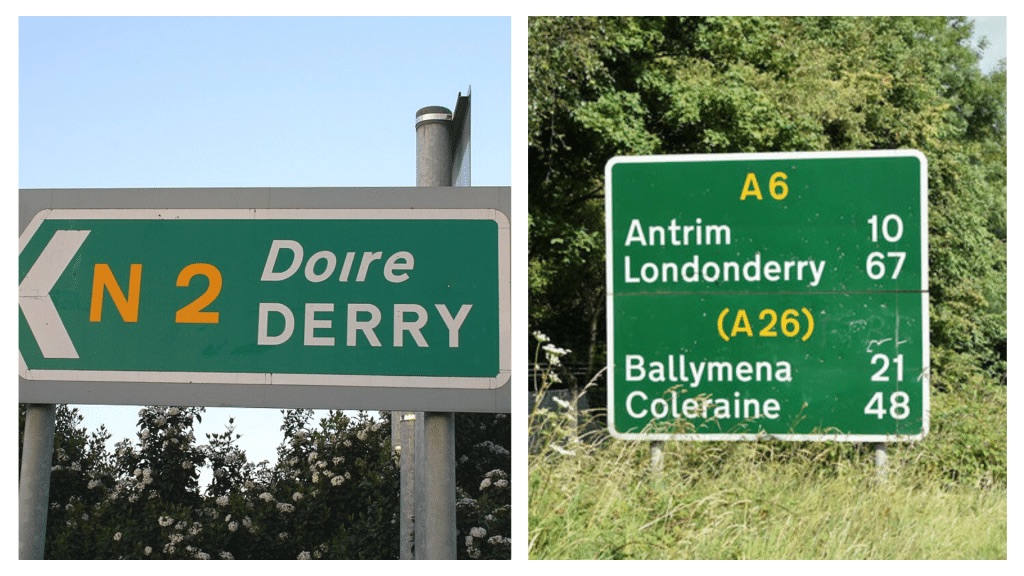
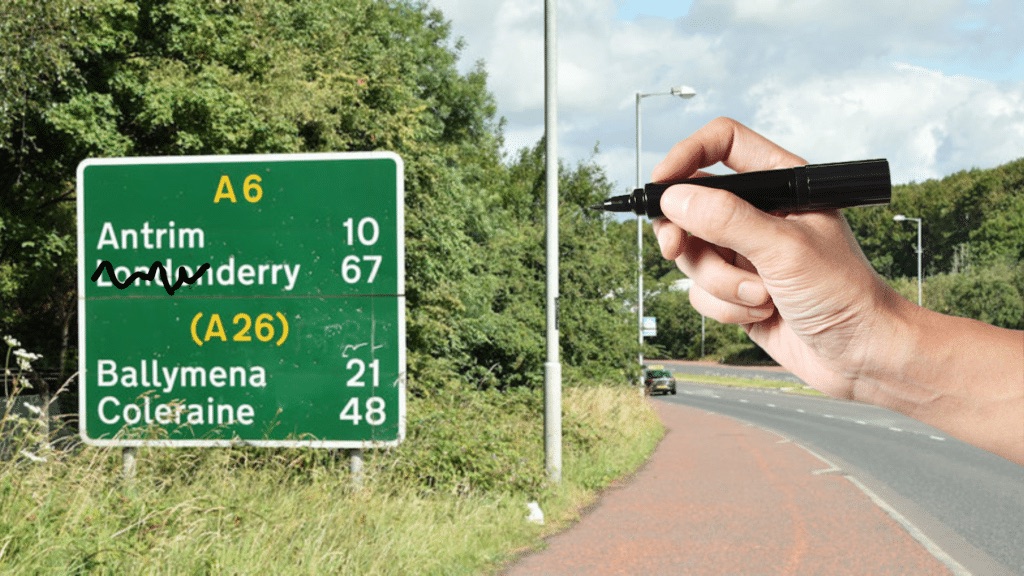
Visitors notice it within an hour of arriving. The station sign says one thing, a shopfront says another, a road sign has been amended by hand. Is it Derry or Londonderry? The short answer is that it is both, and which you use can say something about who you are. Here is where the two names come from and why the question still matters.
Derry: the older name
The older name is the Irish one. Derry comes from Doire (sometimes written Daire), meaning an oak grove or oak wood.1 The settlement began as a monastery founded, by tradition, by St Colmcille, also known as Columba, in the sixth century. Verify the traditional founding date, often given as 546. For roughly a thousand years the place was simply Derry, the oak grove by the Foyle.
Londonderry: the charter and the guilds
The second name arrived with the Plantation of Ulster in the early seventeenth century, when land in the north of Ireland was granted to settlers and companies from Britain. The task of developing this particular area was given to the City of London and its great trade guilds, the livery companies, working through a body called The Honourable The Irish Society, formed in 1613.2
A royal charter of 1613 incorporated the city and, to reflect the London companies' involvement, prefixed the old name with "London": Derry became Londonderry. Under the same scheme the famous walls were built between 1613 and 1618, laid out to protect the new city.3 So the second name is not an accident or a slight; it records who built and paid for the plantation city, and the county around it took the same name.
That is why "Londonderry" is the form you see on the founding charter, on the county, and on many official and legal documents to this day.
Two names, two communities
Over the centuries the two names came to carry meaning beyond their origins.
For many in the unionist and Protestant tradition, Londonderry is the natural name. It reflects the city's charter, its links to London, and a heritage that includes the Siege of Derry of 1688 to 16894, when the Apprentice Boys shut the gates and the defenders held out under the cry of "No Surrender." That history is commemorated in the city every year and is a genuine part of its identity.
For many in the nationalist and Catholic tradition, Derry is the natural name. It is the older, Irish-rooted word, tied to the language and to the city's life long before the plantation. Most people who live in the city, across the communities, use "Derry" in everyday speech, and that is the name we use day to day as well. That habit is not a verdict on the question; it is simply local usage.
Both names, then, are legitimate to the people who use them, and using one or the other can quietly signal where a person stands. Plenty of locals sidestep the choice altogether, saying "the city," or writing both.
The split runs through the city's institutions as much as its conversation. The county and many older and official bodies keep Londonderry, and the Apprentice Boys, who commemorate the siege, use it too. Much of the cultural and sporting life uses Derry, including the football club, Derry City. Even the churches carry both usages in the titles of the dioceses centred on the city. Verify the current names used by the county, the football club and the Church of Ireland and Roman Catholic dioceses. None of this is fixed by any rule. It has simply grown up over four centuries of the two names living side by side, and most people here read the signals without thinking about it.
Stroke City
Which brings us to the nickname. The broadcaster Gerry Anderson, a Derry man, is generally credited with coining "Stroke City," from the habit of writing the place as "Derry/Londonderry," with a stroke, the oblique slash, between the two.5 Verify the attribution of "Stroke City" to Gerry Anderson. It was a wry, good-humoured way of naming the city without choosing a side, and it stuck. You will still hear it used with affection.
Where it stands today
The naming carries through to the present in ways that can look confusing to a newcomer but make sense once you know the history. The local council changed its own name to Derry City Council in 1984, and in 2015 it became Derry City and Strabane District Council.6 Verify the 1984 and 2015 council name changes. Changing the council's name, however, did not change the official name of the city or the county, which in law remains Londonderry.7 Verify the legal position and any court ruling on the city's official name.
You can see the compromise everywhere. The railway station and much of the city's own branding use "Derry~Londonderry," with a tilde joining the two, and that form was used when the city was the inaugural UK City of Culture in 2013.8 Verify the 2013 UK City of Culture branding.
For most visitors today, "Derry" is the more familiar form, helped along by the city's recent cultural profile, from the City of Culture year to the global success of the television series Derry Girls. That familiarity has not displaced the official name, though, and you will still meet Londonderry on maps, signs and paperwork the moment you look. The two simply coexist, as they have for a very long time.
What we tell visitors
People sometimes ask us which name is "correct," hoping to avoid putting a foot wrong. The honest answer is that both are correct, and no one will take offence at a visitor using either in good faith. Say Derry, say Londonderry, say Stroke City if you like. What matters is understanding that the two names hold real history and real feeling for the people here, and that the city has learned, for the most part, to carry both.
Sources and references
The numbered marks in the article link down to this list. Each entry says which claim it backs up, so anything here can be checked at the source.
- Doire / DerryLogainm.ie, Placenames Database of IrelandThe Irish form Doire and its meaning, an oak grove or oak wood.
- About the SocietyThe Honourable The Irish SocietyThe Honourable The Irish Society, its royal charter of 1613 and the part the City of London livery companies played in the plantation.
- The Derry WallsDepartment for Communities (Northern Ireland)The walls built between 1613 and 1618 by the Irish Society as the defences of the new city.
- History of the cathedralSt Columb's Cathedral, DerryThe siege of 1688 to 1689 and the relics of it kept in the city.
- Veteran BBC broadcaster Gerry Anderson diesRTE NewsGerry Anderson and the Stroke City nickname.
- Derry City and Strabane District CouncilDerry City and Strabane District CouncilThe council's name today, Derry City and Strabane District Council.
- Application by Derry City Council for Judicial Review [2007] NIQB 5Judiciary NIThe 2007 judgment of Weatherup J: the city's official name remains Londonderry, and changing it would take a new charter or legislation rather than a council resolution.
- Derry / Londonderry named UK City of Culture 2013GOV.UKDerry / Londonderry as the first UK City of Culture, in 2013.